
When Humanity Held Its Breath
🌀🧠Complex Explainer

Mental Mosaic transforms ideas into tools for high-agency leaders.
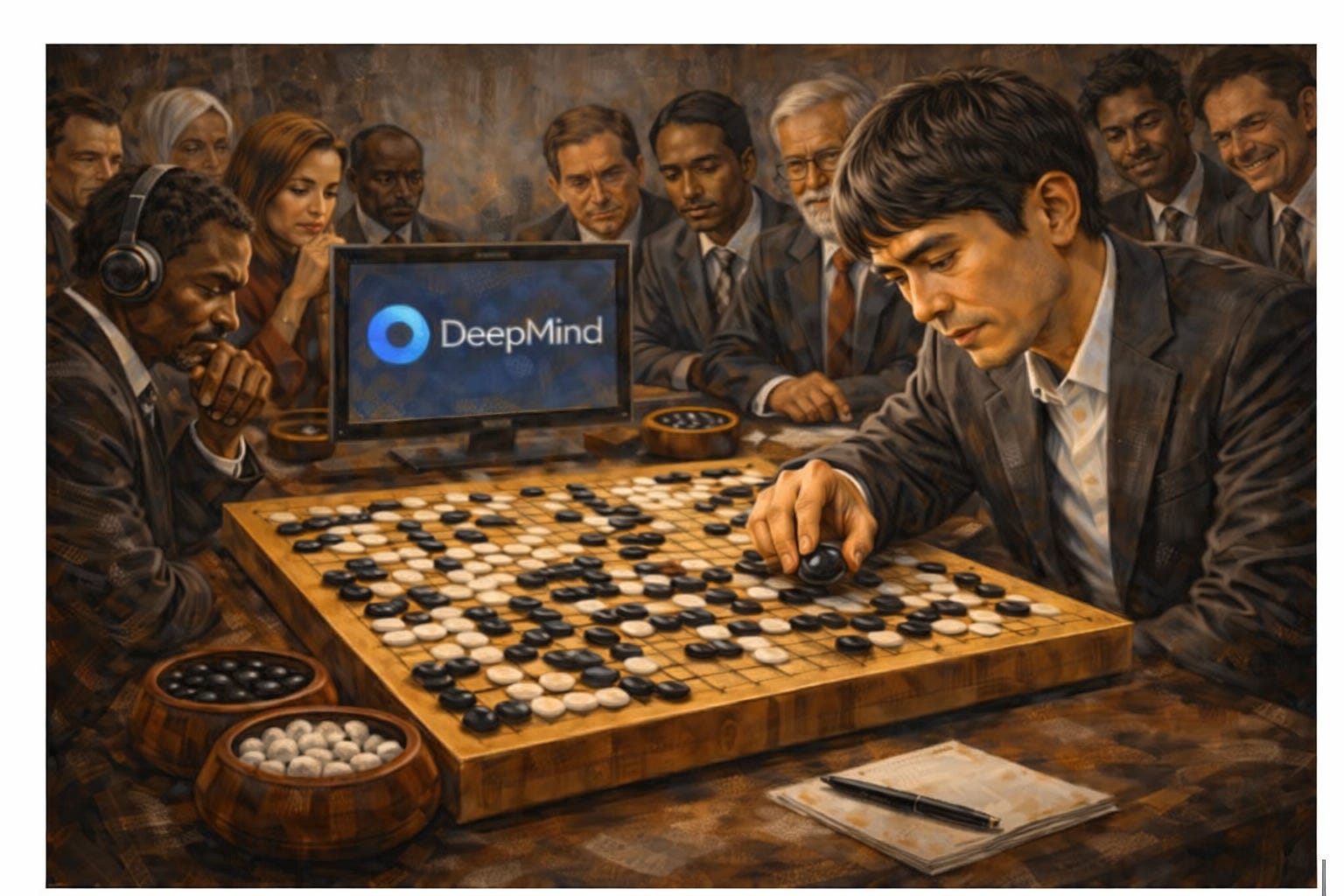
Humanity was rooting for the computer to fail. Go was ours—too intuitive, too human for cold logic to master.
Invented around 2000 B.C. in China, Go is a two-player game in which identical stones are placed alternately on a grid to surround empty spaces. The winner controls more territory than their opponent. Simple rules. Infinite complexity.
Chess offers roughly 35 legal moves per turn and about 10^120 possible games. Go offers closer to 250 legal moves and an estimated 10^360 permutations, an exploding possibility space where advantages often reveal themselves 50 moves into the future. With no material hierarchy (every stone equal), evaluation becomes fuzzy at best.
Chess had fallen to machines. Go remained.
Google DeepMind built AlphaGo, a neural supercomputer designed to do the impossible. After defeating top players across Europe, the machine finally met its match: Lee Sedol, a 9-dan professional, the equivalent of a chess grandmaster, except far rarer.
The match was set for March 2016. Five games. Best of five. The world watched.
The Feedback Architecture
While the world waited to see whether humanity’s champion could hold the line, AlphaGo was doing something remarkable. It compressed years of learning into three weeks by reviewing and playing more than 30 million games, not against humans, but against itself.
AlphaGo didn’t win through raw computing power. It won by learning faster than any human could. The secret wasn’t speed. It was structured.
Its advantage came from tightly engineered feedback loops:
Simulate futures. Play thousands of possible move sequences forward. Check out our prior article on analyzing future outcomes.
Evaluate outcomes. Identify which paths led to winning positions and which didn’t.
Adjust the model. Reinforce patterns that worked. Weaken those that failed.
Repeat. Constantly. Relentlessly.
We can’t simulate millions of scenarios. But we can build the same feedback architecture, just at a human scale
Building Your Feedback Loop
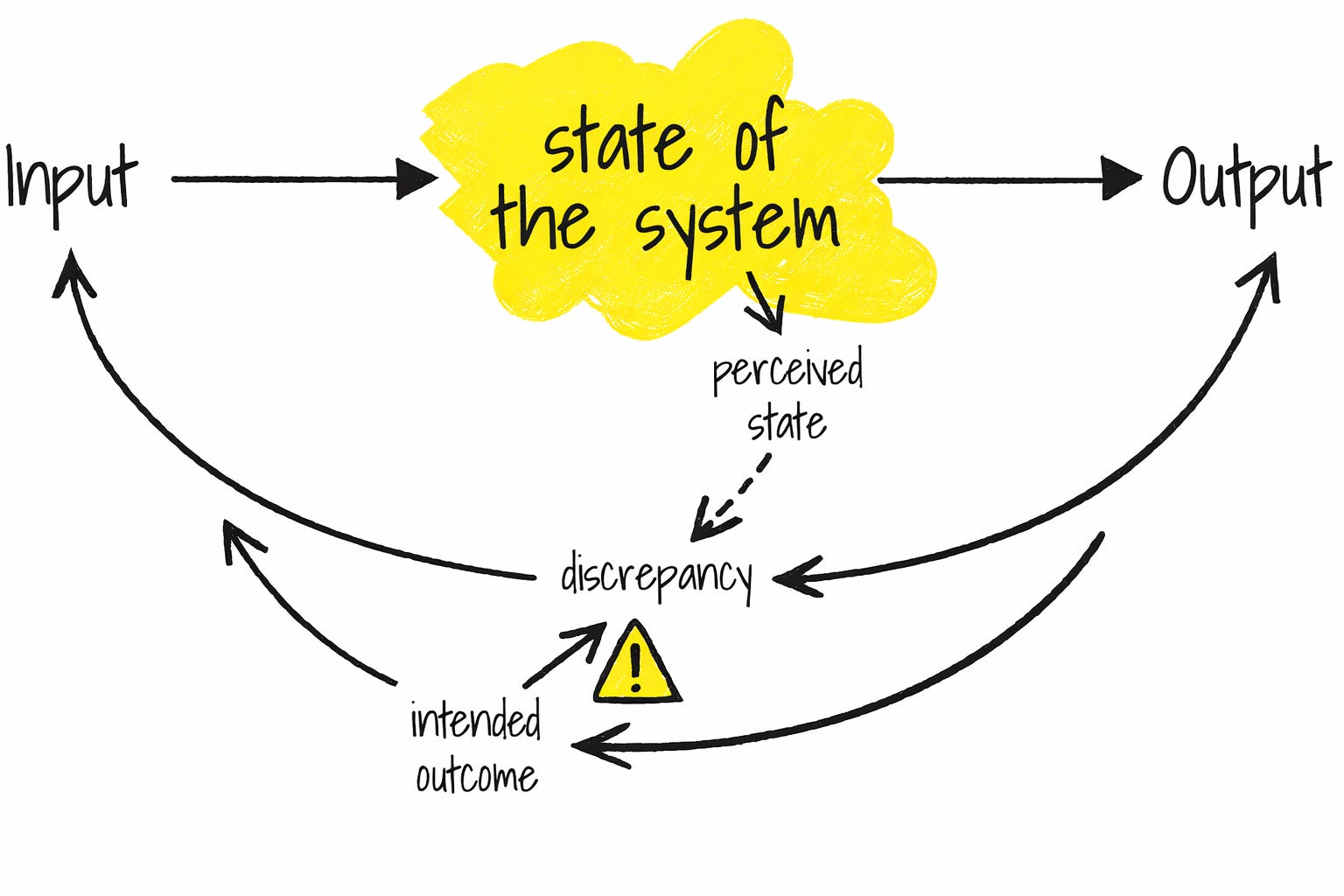
Most organizations treat feedback as an annual event. Information moves slowly. Adjustments arrive late. By the time you realize something isn’t working, you’ve already committed six months to the wrong direction.
This pattern is repeated when sales are poor, efficiency is lacking, or customer complaints are increasing. It’s always a system failure and a feedback issue.
AlphaGo operated differently. Its feedback was continuous, not episodic. Learning compounded daily, not yearly.
The Audit That Wouldn’t Close
During my time as a bank regulator, I reviewed an audit log at a mid-sized institution. Minor issues (documentation gaps, policy violations, control weaknesses) had remained unresolved for over a year.
Management dismissed the findings as minor. The feedback signal was perfect, but it never reached the people who could act on it.
I expanded my review, examined the workpapers directly, and spoke with the Chief Auditor outside management’s presence. I was stress-testing the claim that “these are just minor issues.” If true, the documentation would be thin. The auditor is inexperienced. The conclusions are weak.
None of that was true.
The auditor was exceptional. The findings were serious and well supported. Management had convinced themselves otherwise because acknowledging the issues would require uncomfortable action.
I presented my conclusion to the board: the auditors were doing excellent work, but management was filtering it out.
The board rewired the system. Audit findings now flowed directly to the audit committee, unfiltered by management. The loop closed.
Months later, those same auditors uncovered embezzlement by senior bank officials.
The Four Principles
AlphaGo’s feedback architecture followed four steps: simulate futures, evaluate outcomes, adjust the model, repeat.
That audit followed the same pattern:
Create a clear signal. Auditors generated precise, actionable feedback. The failure came from suppression, not noise.
Play against yourself. I stress-tested management’s narrative before accepting it.
Close the loop. The board didn’t just acknowledge the findings. It changed how information flowed.
Feed results back. They didn’t fix one issue. They redesigned governance for every future case.
We can’t simulate millions of games. But we can build feedback loops that actually close.
Move 78
Lee Sedol lost the match 4–1. Thirty million games of self-play proved unbeatable.
But in Game 4, facing elimination, Sedol found something AlphaGo hadn’t seen in all those simulations. Move 78, a wedge play so creative, so unexpected, that AlphaGo paused for fifteen minutes and never recovered.
Sedol won the game.
One human move out of 280. One moment where intuition saw what data couldn’t.
Human creativity still matters, but only when paired with disciplined feedback. AlphaGo didn’t win because it was smarter than Sedol. It won because its intelligence was structured around tighter loops. It learned from more failures, adjusted faster, and closed the loop relentlessly.
That bank audit worked the same way. Management had judgment, experience, and creativity. But without listening to the feedback their own system was producing, none of it mattered.
The question isn’t whether you’re as smart as the machine. It’s whether your feedback loops are as tight.
Pick one decision you’re making this week. Before committing, ask:
How will I know if this worked?
When will I know?
Who will tell me?
What will I do with that information?
If you can’t answer all four, you don’t have a feedback loop. You have a guess.
Now map it: Where does signal get generated? Where does it flow? Who can act on it? Where does it break?
Find the break. That’s where you start.
If this can help someone, feel free to share:
Stellar comparison between AlphaGo and organizational learning. The audit example where managment filtered the signal is exactly what kills most companies, feedback becomes theater instead of intelligence. Move 78 was legendary tho, shows that structured loops still need someone who can see the pattern no one trained for.
A continuous feedback loop not an episodic one. That's definitely staying with me.
This is a great read. Thanks for sharing!