
The Mathematics of Courage
🌀🧠Complex Explainer

Mental Mosaic- Timeless wisdom, made actionable for life, work & money.
Rather listen to Life of a Show Girl: Risk isn’t math — it’s emotion measured in numbers. The goal isn’t to avoid volatility, but to choose the kind you can live with.
The Restless Moment: What “In the Mood for Love” Teaches Us About Risk
Wong Kar-Wai’s tantalizingly beautiful film In the Mood for Love is a penetrating meditation on longing and restraint.
In one of its most charged scenes, we find the film’s two would-be lovers in a narrow corridor, their faces inches apart, their fates at a threshold:
“It is a restless moment,” the narrator says.
“She has kept her head lowered…to give him a chance to come closer. But he could not, for lack of courage.”
Kar-Wai’s tale of unconsummated love is often cited as a masterpiece. Perhaps it resonates so deeply because it conjures our own missed opportunities — that time we passed on a startup job for the perceived safety of a corporate position, or we put aside our dream of studying music to secure a career in finance.
Risk Isn’t Just for Bankers
By day, I underwrite loans to companies. That means I live in the world of risk analysis. For me, Kar-Wai’s mesmerizing film is also a visual portrayal of the unseen force that haunts every missed opportunity: our tense relationship with risk.
Knowing how to analyze risk is a life-changing skill, yet it’s rarely taught. It means knowing when to leap, when to wait, and how to think about the odds of success.
What few people realize is that the same tools Fortune 500 companies use to maximize profits can also guide everyday decisions — even those as personal as a romantic encounter.
On the surface, measuring risk sounds wonky and technical. But it’s actually more of an art — a constant dance with possibility and risk.
How to Think About Risk
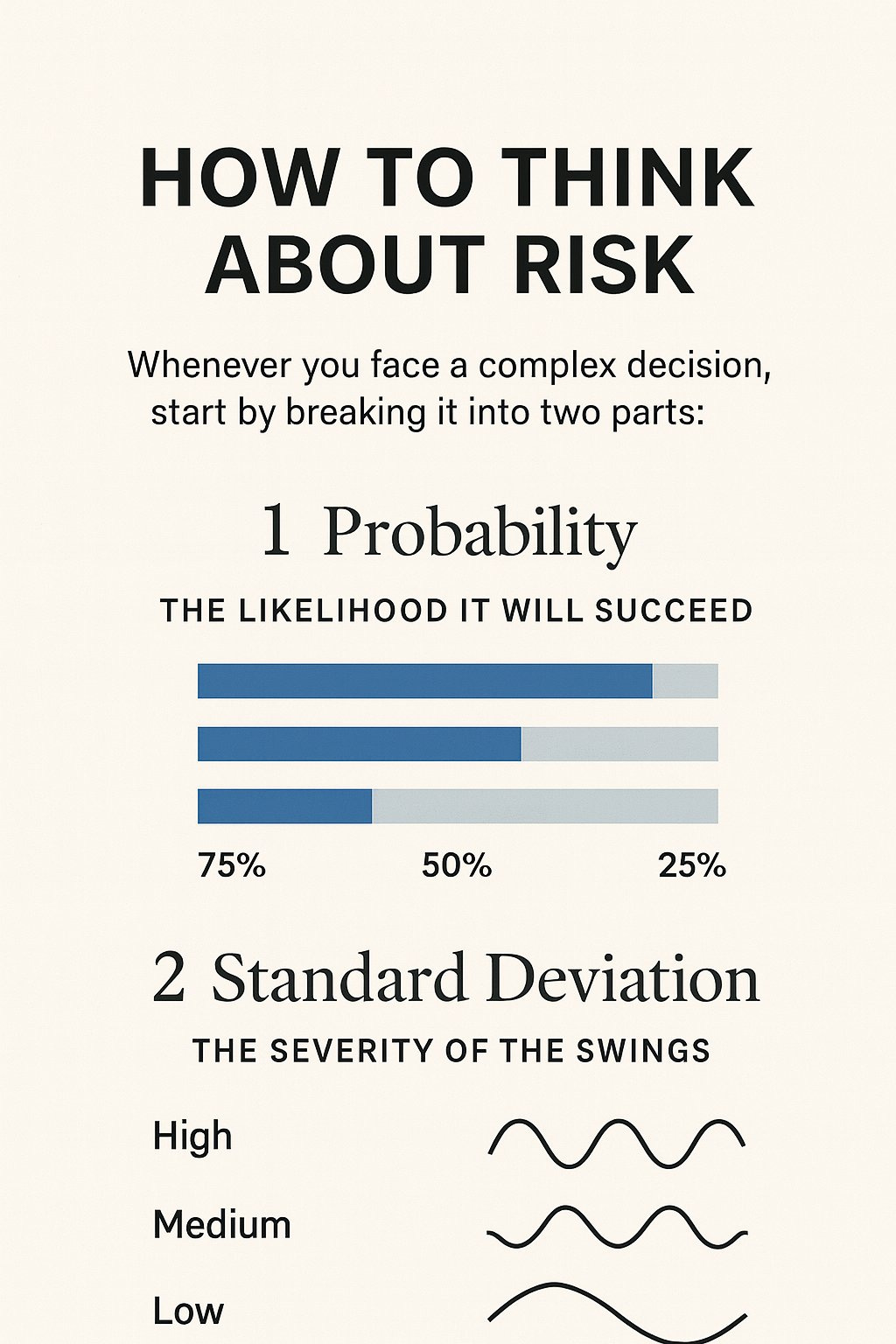
When it comes to the core concepts of risk analysis — probability and standard deviation — you don’t need complex formulas, just intuition.
Here’s how it works.
Whenever you face a complex decision, start by breaking it into two parts:
The likelihood it will succeed (probability)
The severity of the swings (standard deviation)
1. Probability — The Likelihood of Success
Let’s start with number one. Consider a few benchmarks:
75% → strong odds
50% → a coin flip
25% → weak odds
Going deeper, the trick is that you can’t simply ask “Will it work?” but rather, “What’s the cost of making it work — and is that cost worth it?”
Say you want to launch a startup. Landing your first customer is going to cost $50 k and months of sleepless nights. Is that worth it? It depends. If it sells for $55 k, most people would say no. But what about a 10 percent chance at $10 million? That’s interesting.
In that case, what can you do to improve your odds?
Here’s another rule of thumb: the costlier the pursuit of success, the higher your payout should be. That means calculating personal costs too. Missing dinner every night to get the business off the ground could mean missing out on seeing your son grow up. Are you okay with some regret?
2. Standard Deviation — How Wild Are the Swings?
This is where we consider standard deviation — a measure that tells us how volatile the prices, returns, or even just the expected benefits are.
We can usually break that down into three categories:
Low Standard Deviation → Stable: Investing in treasury bills, parking your money in a savings account, holding a tenured job.
Medium Standard Deviation → Manageable Swings: Investing in Apple stock, buying a home, switching jobs in the same field.
High Standard Deviation → Wild Swings: Investing in crypto, opening a restaurant, moving to a new country for work.
The question to ask here is: Can you handle the swings?
If your startup loses $50 k, are you okay with that? What about $200 k? Can your family still make ends meet and buy a house while you build the startup?
Another way to ask this is:
“Am I prepared — emotionally and financially — to live through the volatility?”
When Risk Meets Reality
This isn’t just theory. I once saw it play out with the fantastic collapse of New York’s once rock-solid market for taxi medallions.
Because the cabbie system was tightly regulated, bankers had long assumed medallion prices would rise forever. From their perspective, this meant that taxi owners could always pay back their loans.
As medallion prices continued to rise, I began to have doubts. When I ran the numbers, I found that a cab would have to be in service 24 hours a day to make debt payments.
When I pointed this out to a banker, he waved it off:
“Easy — 12 hours for one cabbie, 12 for the other.”
What the banker missed was the standard deviation. Volatility was creeping in. Burned-out drivers faced enormous stress in trying to pay back loans, and new technology — Uber — was poised to capitalize on a lucrative market.
Before long, the medallion market collapsed.
Whether in our business or personal life, we can’t simply ask, “Will this work most of the time?” We also have to ask, “What happens if things swing against me?”
The Takeaway
💬 Pull-Quote:
“Risk isn’t about math — it’s about courage.”
Wong Kar-Wai’s film lingers on longing — but our own stories don’t have to.
The restless moment is always here.
The question is: should you leap?
You've convinced me to add this film to the must-watch list.