
Trust Me, I've Got You
🛠️ A Sharp Model: What a Kyoto sushi chef taught me about competitive advantage.

Mental Mosaic transforms ideas into tools for high-agency leaders.
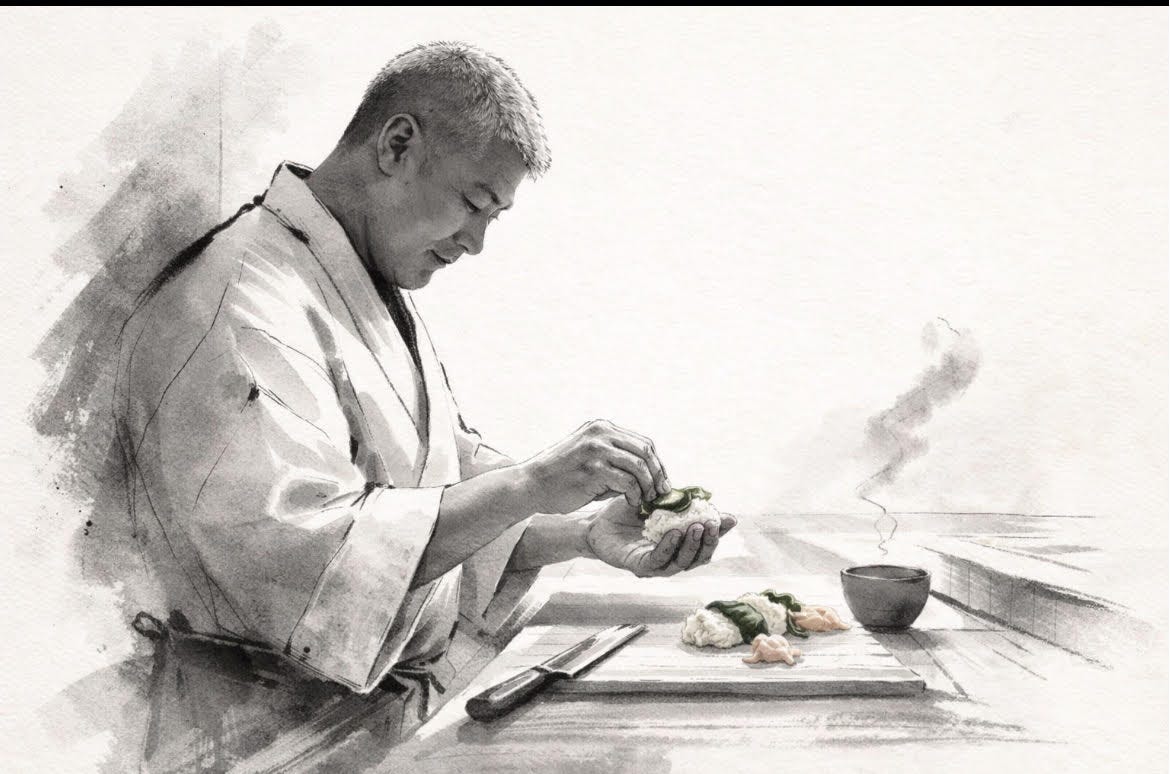
The small sushi shop was off the beaten path, away from tourists. Google Maps struggles to navigate Kyoto’s byzantine streets, bustling with activity. Little crooked lanes branched off the main ones. We finally found the hole in the wall. A sign hung on the corner with deference: ‘Sorry, I can only seat five people.’
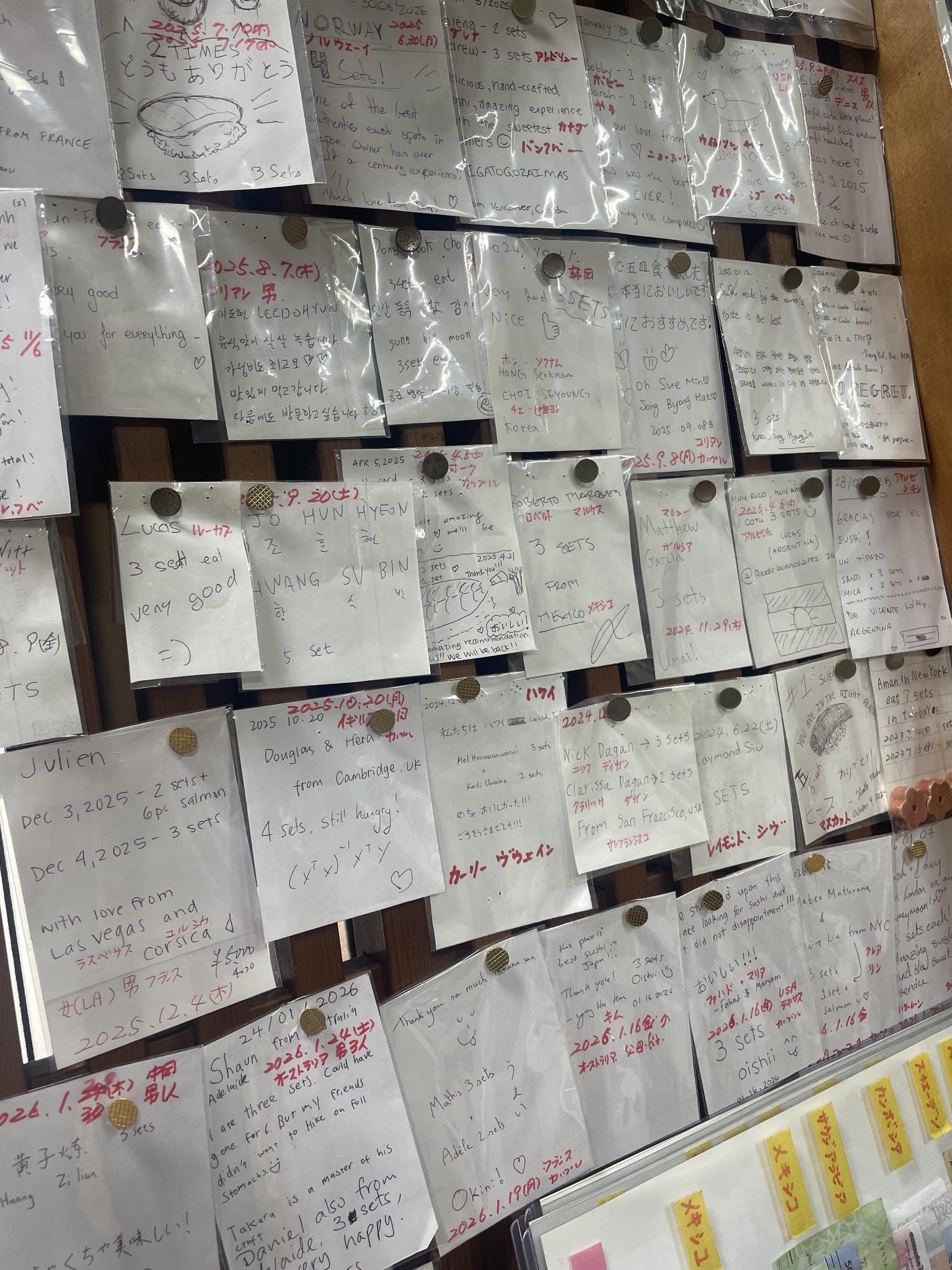
As we entered, the sushi chef smiled as though he’d been expecting us. We were relieved to be the only ones there. As we sat down, from the corner of my eye, I could see little notes of customer affection for the elderly chef: ‘We had seven sets. Wish I could eat more.’ ‘We had five sets.’
He pulled out his phone, spoke in Japanese, and let it translate to English. He carefully handed us the menu. Asked where we were visiting from. When we mentioned New York, he asked whether we thought the new mayor could bring down prices. He kept detailed notes on every customer who visited. He knew exactly when the person who sent us had visited, down to the date and time.
Once we placed the order, it was all business. His hands moved with quiet precision, each cut deliberate, each placement intentional. He had been operating the restaurant since the 1970s. A little boredom would be justified. There was none. As he placed the sushi in front of us, he told us which to eat with and without soy sauce. This was a command. We were not to mess up his work.
Japan, as I found out, has a lot of amazing sushi. But the unreasonable care of this man in his tiny restaurant will stay with me forever. Not because of the fish. Because you could feel that this was his life’s work, and he refused to be casual about it.
That refusal is becoming rare. In the age of technology, gross margin protection, and quarterly earnings, most businesses have optimized the care out of the process. The customer feels it immediately. Not as outrage. As indifference. A shrug where there used to be a standard.
The pattern is simple. When people care about what they do, customers never have to ask for more. When they don’t, no amount of process can fake it.
So the question worth sitting with isn’t how do we improve the work.
Do we actually care about it?
And if the answer is no, the honest move is to stop doing it and find the thing you’d refuse to be casual about. The sushi chef didn’t need a mission statement. He had a five-seat counter and fifty years of proof.
He’s not alone. But he’s increasingly outnumbered.
The Case for Unreasonable Care
We’ve all sat through the call tree. Pressed 1, pressed 3, repeated our account number twice, only to reach someone reading a script. Now the script is an AI chatbot. The human has been optimized out entirely, and it’s celebrated as a win for the bottom line.
Care is increasingly reserved for the top end. We’ve all walked past business class to economy. But care was never supposed to be a seating class. Some companies still prove it doesn’t have to be:
Zappos: A customer once stayed on the phone with a Zappos rep for 10 hours and 43 minutes. The call covered life, relationships, and yes, shoes. Reps weren’t measured on call time. They were trained to build connections, not rush. Founder Tony Hsieh built the entire model around one idea: treat support as marketing, not a cost center. Long-term loyalty over short-term efficiency.
Chewy: When customers call to cancel after a pet passes away, Chewy doesn’t process the transaction. They send handwritten sympathy cards. Flowers. Refunds with no return required. They tell customers to donate the unused food to a local shelter. If you’ve ever loved a dog, imagine that call. That emotional moment doesn’t just resolve an account. It defines the brand. Emotional intelligence scales.
The Omakase Principle
Omakase literally means “I’ll leave it up to you.” It’s the ultimate expression of trust between customer and craftsperson. But that trust is only earned through obsessive care. The framework has four steps:
Seat — Define your constraint. What’s your five-seat counter? Shrink the surface area until you can feel every interaction.
Select — Audit ruthlessly. Do I care about this? If yes, go deeper. If no, cut it. The chef didn’t offer mediocre tempura. He made sushi and nothing else.
Command — Find your soy sauce moment. If you don’t have an opinion about how your work should be experienced, you don’t care enough yet.
Sustain — Apply the boredom test. Fifty years and still no boredom? That’s care. Boredom creeping in? That’s not a discipline problem. That’s a signal to move on.
The beauty of omakase is that the customer surrenders control and gets something better than what they would have chosen. That only works when the person behind the counter has cared long enough and deeply enough to be trusted with the choice. The framework is the path to earning that trust.
In Closing: The Care Compound
The reality is that speed, shortcuts, and margin often take precedence over lasting relationships and great products. And there’s a feedback loop: the more employees feel like a number on a spreadsheet, the harder it is for them to care about the customer on the other end. Apathy compounds. It moves from the boardroom to the front line to the customer and back again.
But the reverse is also true. Care compounds, too. Showing a little of it to everyone around you and in the work you do doesn’t just improve the product; it changes the environment. And that might be the most unreasonable thing of all: that something so simple is so rare.
Lovely post to start the day. Would love to hear what omakase means to you, and where you apply this principle.
the value-per-word on the omakase section was next level. i'm gonna print that part out.