
The Power of what’s Left Unsaid
🧩 Mental Engine: On negotiation, invisible needs, and the gap where deals die

“Between what is said and not meant, and what is meant and not said, most of love is lost.” - Khalil Gibran.
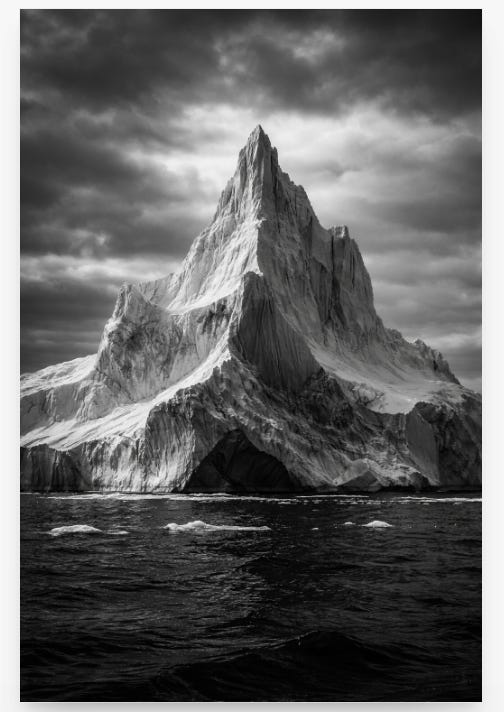
Sooner or later, you're sitting across from someone who wants something different from what you do. And it is often a sad fact of life that negotiations, by their very nature, place both sides in an antagonistic, zero-sum tussle (if not an actual struggle). When both parties come into it with that mindset, what is said between them during the talks is only the tip of the iceberg. Go below sea level, and you will find that each side has an underwater frozen mountain of intentions, desires, stresses, and conflicts driving that tussle and ready to sink the deal.
It got me thinking about the aforementioned quote by Lebanese-American poet Khalil Gibran. Swap love for deals. Swap it for peace. The gap is the same.
Ultimately, every negotiation has two layers: what’s being discussed, and what each party actually needs — the visible and the invisible. The argument on the surface is never really the argument.
The Conflict: Every Demand Has a Shadow
The visible is what people argue about. These are the obvious stated agenda items. These can include price, terms, structure, time, stated positions, and perceived options.
The invisible is what’s actually driving the negotiations. They’re what the parties are actually fighting for and what has brought them to the negotiation table. These are things like causality (why they’re there), the narrative they tell themselves (history, identity, culture, emotion), the true constraints they face, their actual options, and timing (as opposed to time).
We see these factors come into play in almost any negotiations.
Zoom in: Take a typical divorce settlement:
The visible: Add up the assets, subtract the liabilities, split the difference.
The invisible: Anger, betrayal, rage, and grief — emotions that rarely get a seat at the table.
Zoom out: We can even see this interplay in global affairs, including the current conflict in the Middle East:
The visible: We have sanctions, strikes, and nuclear brinkmanship, and the Strait of Hormuz.
The invisible: We have survival, sovereignty, historical ethnic and religious grievances, and the control of a region that powers the global economy.
The Conflict: Ignore the invisible at your own peril
On the surface, it seems pretty obvious that people negotiate for the material and stated outcomes, and that they won’t engage in an inherently antagonistic interaction with their cards on the table. So, why bother with the invisible? (What’s underneath the iceberg.)
Because for most, the visible is there to satisfy the invisible need. Without satisfying the latter, most negotiations either break down or one side ends up feeling wronged by the deal. And deals can fall apart after an agreement is reached.
Furthermore, engaging only on face value is inherently limiting and risks one losing the prize. That is because:
Limitations of language: Negotiations are verbal, and language only approximates intent, not necessarily reflecting each party's needs. Language can also become a tool of misdirection as much as communication.
Fog of War: People guard information like currency, revealing only what advances their position and withholding what might expose their need, true position, and real constraints.
BATNA: And by failing to analyze the invisible properly, one fails at discovering their true leverage: When to walk away or their Best Alternative to a Negotiated Agreement (BATNA). A BATNA gives the clearest picture of what walking away would actually cost. It forces a reckoning with reality rather than ego.
The Framework: Drive to unearth the invisible
When entering a negotiation, the first job isn’t to state your position — it’s to map the invisible needs beneath it by:
Understanding each side’s real pain points: What are their true constraints, including time, financial and other material costs, and reputational damage?
Running an honest BATNA analysis to figure out when and at what point to walk away.
Perception vs Reality: Understanding what the perceived options are as opposed to the actual options.
Narrative vs price: Taking the other side’s emotions, history, and grievances seriously enough to actually understand them. Addressing the narrative, not just the price, may keep the deal alive well after the talks are done.
Not to agree. To Understand
And when mapping the invisible, it helps to ask the following questions:
What are they saying? (visible)
What must be true for them to say it? (invisible)
What can’t they change? (constraint)
What story are they protecting? (narrative)
How many options do they think they have? (perception)
Who is under real-time pressure? (timing)
Will they regret this deal later? (aftermath)
Remember, a deal is only real when both sides feel they gave something up. The best negotiators don’t just win. They make the other side feel like they did too.
The iceberg doesn’t warn you. It just waits.
Tell us about a recent negotiation:
Pretty sure Carl Jung would agree with you. People's shadows drive so many of their actions, and few people are willing to confront their own shadow, let alone other people's shadows.
I have to look into Carl Jung more! Thank you for that.