
Your Amygdala Is Running the Meeting
🛠️A Sharp Model

Mental Mosaic turns ideas into tools for high-agency leaders.
Trying to survive both gift-giving season and difficult conversations? Section three has the part that saves your sanity.
How Sony Lost the MP3 War: The Biology Behind Bad Decisions
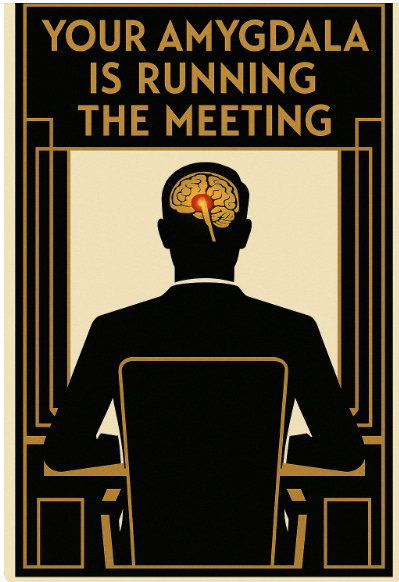
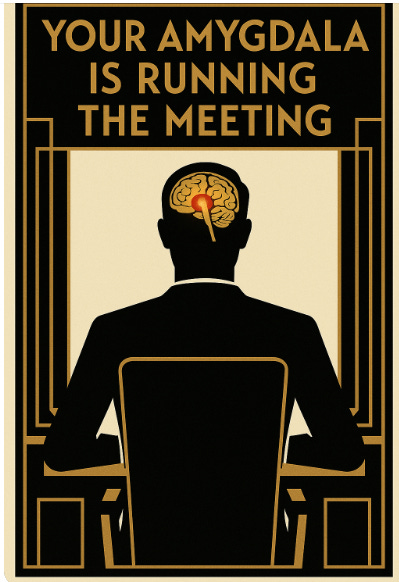
In his legendary black turtleneck, Steve Jobs walked onto the stage and redefined personal music:
“This amazing little device holds 1000 songs. And it goes right in my pocket,” said Jobs.
For Sony, it was a nightmare.
Until then, the Sony Walkman dominated personal music. However, a digital revolution was underway. Years before Apple rolled out the iPod, Sony had the tech for an MP3 player. But when the moment came, Sony froze. Executives saw MP3s as a threat and succumbed to the biology of fear.
In the annals of business, it was an unlikely turn. It began with an uncomfortable conversation years ago in Tokyo, where two of Sony’s most powerful factions stared each other down:
On one side: the innovative hardware division, makers of the Walkman, pushing for an early MP3 player.
On the other side: Sony Music executives, guarding the company’s tightly controlled music catalogue. With MP3s being pirated off Napster and LimeWire, they saw an existential threat to their profits. So why enable their use?
Two brilliant teams were fighting over territory, identity, and survival.
Fear of Difficult Conversations
For most of human history, survival depended on staying inside the tribe. Challenging the “peace” risked rejection.
The brain treats conflict like danger and launches a threat response:
In 200 milliseconds, emotion overrides logic. Stress hormones surge. Social pain lights up the same area of the brain as if you are getting hurt. Attachment and safety get activated.
Difficult conversations feel hard because we’re wired for survival, not confrontation.
So what did our Sony Executives do?
They went with a digital Walkman that couldn’t play MP3s. Every track had to pass through proprietary software (i.e., wrapped in digital barbed wire to prevent piracy). Both teams saved face. Sony lost the future.
The BREATHE Framework for Difficult Conversations
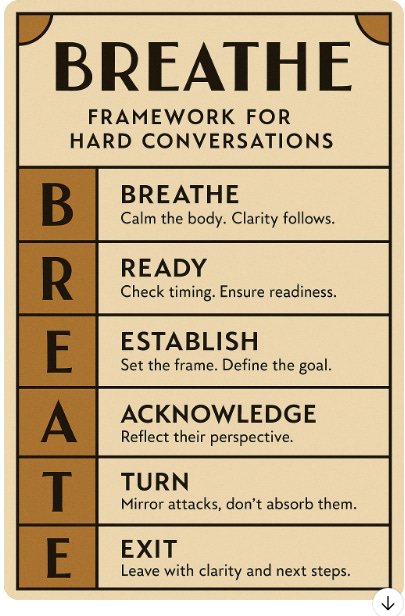
In the heat of the moment, you have to understand that a mix of ancient hardware, biology, and chemistry is influencing you. Business success requires navigating difficult conversations. The key is to have a learned set of behaviors that calm your nervous system so that the logical brain can pilot the conversation.
B – Before engaging
Take three slow breaths. Let your body calm down before you speak.
R – Ready check
Ask: “Are we both ready for this conversation?”
If not: “Let’s talk when we’re both ready—how about [timeframe]?”
E - Establish the frame
Open with explicit structure: “I’d like to talk about [specific incident]. My goal is for us to understand each other better and move forward. I’m hoping we can both feel heard and respected.” This creates psychological safety and shared purpose.
The key here is to drive a conclusion. Look at the end of this, I’d like to come up with a new process for xyz, or the big principles of the merger will be decided, or we walk away.
A – Acknowledge their perspective
“I understand you feel…”
“Thank you for telling me this.”
Validate, don’t necessarily agree.
T – Turn attacks into mirrors
When they get sharp, reflect:
“Is that how you’d want me to speak to you?”
Invite awareness instead of escalation.
H – Hear without defending
Listen to understand, not to reload your argument.
E – Exit with clarity
Summarize what you each heard and agreed to.
Thank them for staying in the conversation.
4. Mastery Under Pressure
Whenever you are building something, conflicts are inevitable. The best know how to rise above them. For example, Jamie Dimon, the “banker’s banker,” has weathered multiple financial crises. When the world is on fire, presidents and competitors alike lean on him for advice. That’s because he keeps a steady hand, even as others are spiraling.
Next time you feel the rush, BREATHE.
If this resonated, leave a comment or hit reply and tell me where difficult conversations show up in your world. Your answers shape future essays.
I was at a work conference recently. Got into a heated argument over a topic that, in hindsight, no one was going to "win." I actually may have sabotaged a relationship that was, until then, incredibly interesting... Had I simply stopped and caught my breath, I wouldn't be cringing each time the memory of that evening re-surfaces...