
What a $50,000 Watch Taught Me About Decisions
⚙️Mental Engine

Mental Mosaic transforms ideas into tools for high-agency leaders.
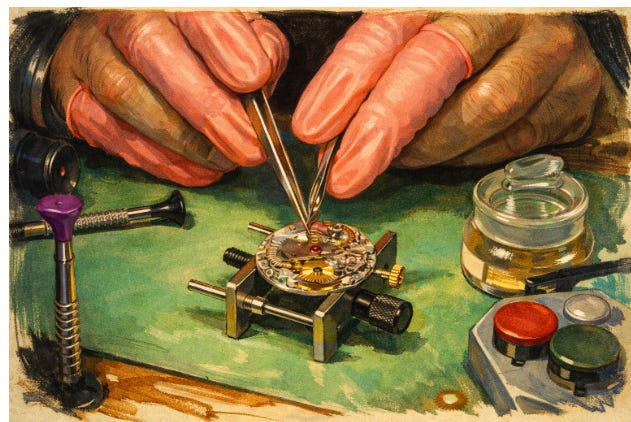
Some problems reward velocity. Others demand the watchmaker’s hand.
No one pays $50,000 for a watch because it tells better time. A watchmaker obsesses over parts no customer will ever see. A screw the size of a comma, oiled with a droplet at the edge of visibility. Excess oil is arrogance. Too little is neglect.
After the 2008 crisis, I met the CEO of a successful community bank in New Jersey. Unlike his peers, he never touched mortgage-backed securities, despite years of pressure to do so.
“People a lot smarter than me told me it was bulletproof,” he remarked.
He continued, “My sister bought a house in an expensive part of Florida. Before she signed anything, I asked to see the mortgage paperwork.”
“I’ve been a banker for 30 years,” he told me. “I couldn’t make heads or tails of these documents. And when I couldn’t understand my sister’s mortgage, I knew no one understood a product made of millions of these mortgages.”
He didn’t say, “Let’s buy a little and see what happens.” He chose not to move at all.
In that moment, he was a watchmaker. He knew this was not a place for speed. It was a place where misunderstandings would quietly compound, long before they became visible. How do you tell the difference?
A company’s core demands watchmaker precision. Its edges forgive speed.
Break Loud vs. Drift Quietly
For years, Silicon Valley preached a single commandment: move fast and break things.
Some problems reward velocity: marketing tests, minor product updates, or trying a new way to reach new customers. Failure here teaches quickly. You move, learn, adjust. The cost of being wrong is measured in weeks and wounded pride.
Other problems demand the watchmaker’s hand: security standards, your people, your organization’s core architecture. Failure here compounds in darkness. By the time the gears lock, the damage is done.
Boeing spent decades as the gold standard of aerospace engineering. Then they made hundreds of small decisions that seemed reasonable in isolation: outsource more components, reduce engineer oversight, let schedule pressure override safety reviews.
No single decision killed 346 people in two 737 MAX crashes and wiped out $60 billion in Boeing's market value. But together, they created a drift-quiet failure that took years to compound and seconds to reveal.
The MCAS system failed because Boeing treated a core safety system like an iterative product feature. They moved fast on something that demanded the watchmaker’s hand. By the time the crashes happened, engineers who raised concerns had already been overruled. Pilots weren’t told the system existed.
Decide where speed is safe, before speed decides for you.
DRIFT MAP
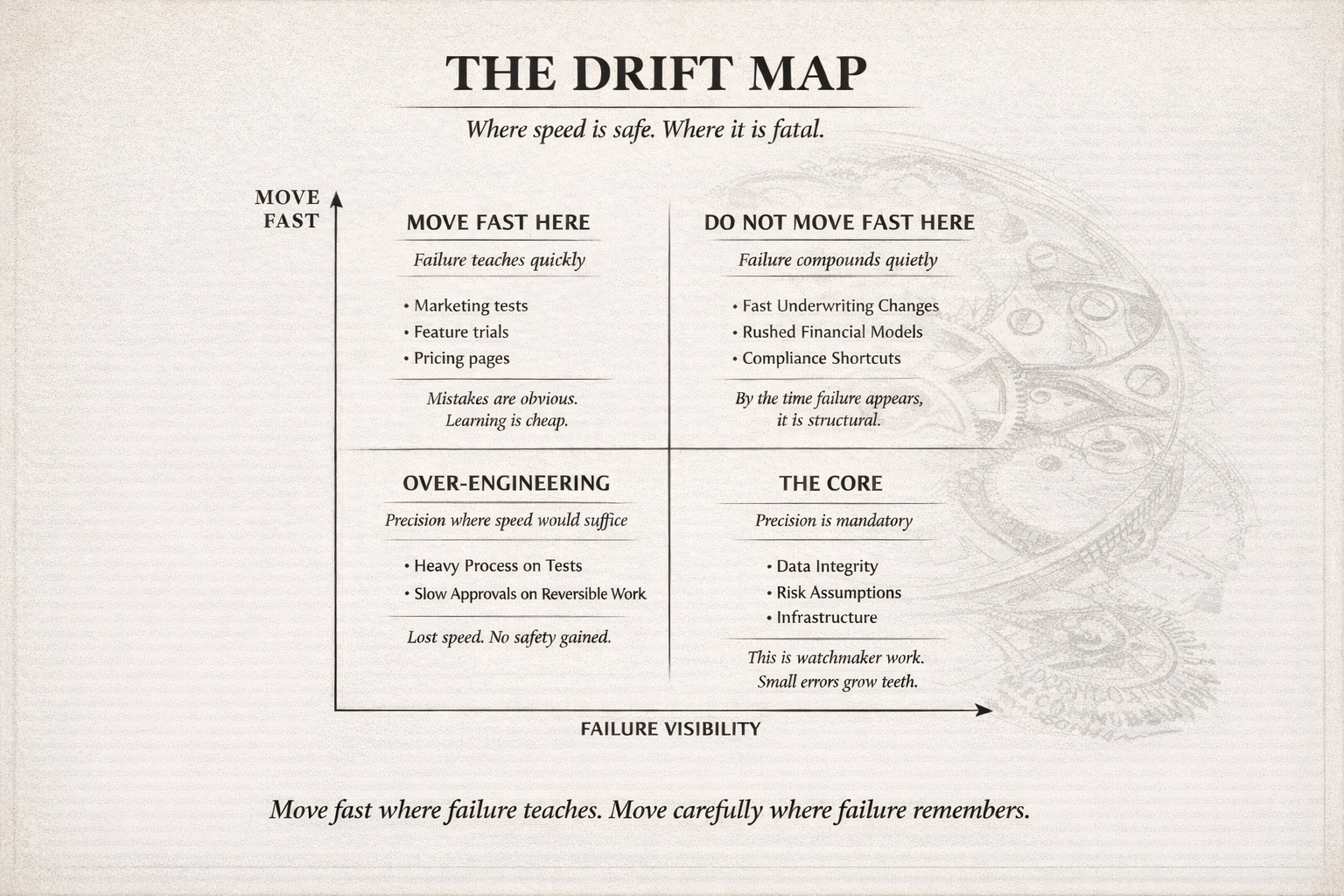
Start by classifying every system in your business with one question: If this fails, does it break loudly or drift quietly?
Once you know which is which, the protocols become obvious:
For break-loud systems: ship early, iterate aggressively, treat reversibility as your advantage. Keep experiments short. Keep the blast radius small.
For drift-quiet systems: require pre-mortems, mandate second reviews, never accept “temporary” hacks.
But classification alone isn’t enough. You need detectors, such as specific metrics that move first when something starts failing. If no one owns detection, drift is already underway. For example, in commercial lending, growing past due where customers don’t share their financials is often an early indicator of potential credit losses.
Speed is not courage. Slowness is not weakness. Wisdom is knowing which problems forgive mistakes, and which never do.
Move fast where failure teaches.
Move carefully where failure remembers.
Some errors correct themselves.
Others keep time.
Know the difference.
If this helped you think more clearly about speed and judgment, consider sharing it with someone who makes hard decisions.
Great post! Throughout reading it, I couldn't help thinking that the same principle applies to personal finance decisions. This line, in particular, captures the overlap perfectly: "Speed is not courage. Slowness is not weakness. Wisdom is knowing which problems forgive mistakes, and which never do." Very Buffett-like wisdom in this post, for both organizations and families.
Wow so well said. Love it, saving it.