
The Unstoppable Budget
Why is our Federal Budget so high?

A veteran I used to work with once told me something that stuck with me. Most of his friends back home hated any talk of defense spending cuts — and not just because of national security. They grew up in a town that made parts for fighter jets. When the defense budget got slashed in the ‘90s, the jets went with it. And so did the town. While the rest of the country rode a decade-long boom, his neighbors watched their hours get cut and their houses foreclosed on.
He said it created a tension he never fully resolved: he understood the budget deficits were unsustainable, but understanding something intellectually doesn’t make it hurt less when it’s your block.
That tension is exactly why the federal budget matters — and why most people tune it out at their own expense. Government spending isn’t an abstraction. It shapes which industries survive, which towns thrive, who gets healthcare, and which jobs exist in the first place. The budget isn’t just a spreadsheet. It’s a map of the country’s priorities — and if you don’t know how to read it, someone else is making those decisions for you.
Part 1: What Is the Budget — and What Is It For?
A Tool for Fiscal Policy The federal budget is the government’s primary lever for managing the economy. By adjusting spending and tax policy, Washington can stimulate growth during downturns or cool an overheating economy.
A Financial Tool to Track and Limit Spending and Revenues. At its most basic, the budget is a ledger — it accounts for every dollar the government expects to collect and spend in a given year. It sets hard ceilings on agencies and programs, making it the mechanism through which Congress controls the national purse.
A Comprehensive National Strategy and Policy Document. The budget is also a statement of priorities. Where the money goes reveals what a government actually values — far more than any speech or platform ever could.
A Gauge for the Economy Economists and markets watch the budget closely as a signal of the country’s fiscal health. Deficit levels, debt-to-GDP ratios, and spending trajectories all tell a story about where the economy has been — and where it’s headed.
Part 2 - Reading the Budget FY2025:
A. Revenue: Let’s begin with sources of revenue for the US Government - mainly taxes:
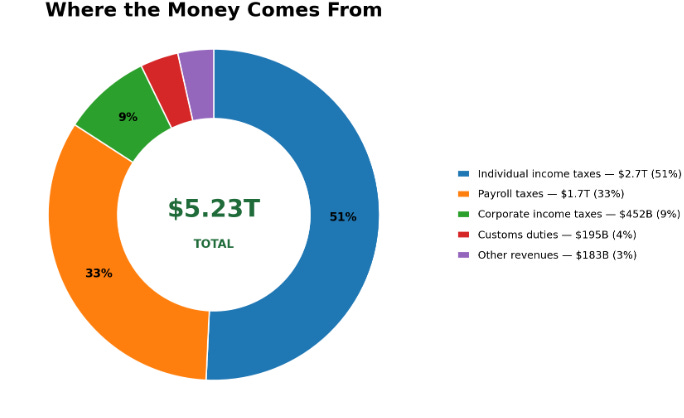
Most federal revenue comes from three sources: what you pay as an individual (income and payroll taxes), and what corporations pay on their earnings.
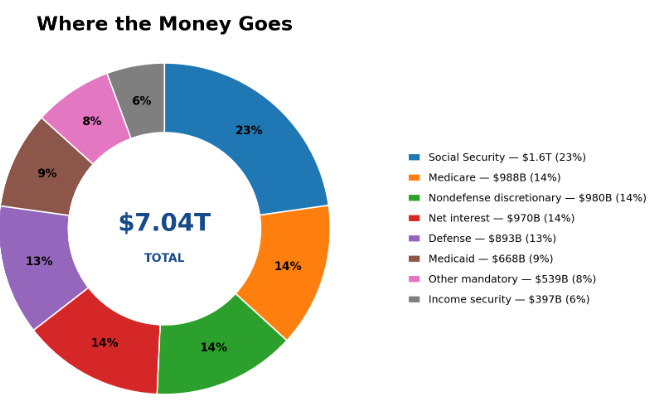
B. Expenses: When you add it all up, the federal government is largely in the business of three things: taking care of its people, paying for its protection, and servicing the cost of years of doing both on credit. This results in the following categories, which are well known:
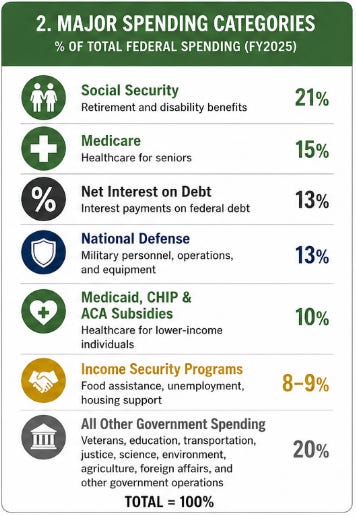
Strip it down to the essentials: the US government spends most of its money on four things — healthcare, Social Security, defense, and the interest it owes on money it already borrowed.
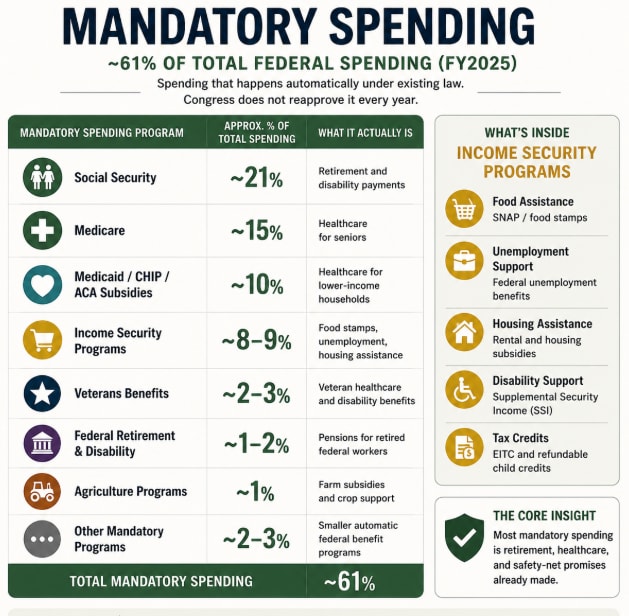
C. The Growing Budget: The math isn’t subtle: $5.3 trillion in, $7.1 trillion out — a $1.8 trillion gap. The reason it keeps happening is structural. Sixty percent of the budget is locked in by law and is called mandatory spending. Congress generally cannot cut back on this without a change in law:
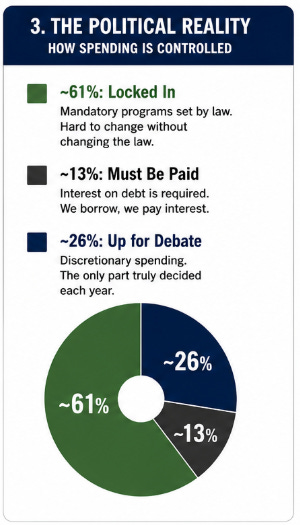
Add onto it what must be paid, and very little of the budget is actually negotiable each year, which makes controlling our deficits very difficult:
The Debt Conclusion:
The National Debt: $38.5 Trillion
The national debt has two components: money the government owes to outside lenders, such as foreign governments, pension funds, and everyday investors (public debt), and money it owes to itself — borrowed from programs like Social Security (intergovernmental debt). Then there’s the cost of carrying all of it: interest payments, or debt service.
The debt accumulates the same way it does for anyone who spends more than they earn — they borrow the difference. Every year, the government runs a deficit, and it finances the gap by issuing Treasury bonds. Investors buy those bonds, the government gets cash, and the total balance grows. Do that enough years in a row, and $38.5 trillion is what you get.
Combined, the total sits at $38.5 trillion. As a share of the economy, public debt has now reached its highest level since World War II — the last time the country spent like the bill didn’t matter.
So what’s the big deal?
America’s debt matters. Rising interest costs reduce flexibility, and long-term deficits cannot grow forever. But the United States is not a normal borrower. The world stores capital here because of deep financial markets, strong property rights, relative political stability, military strength, innovation, and the enduring belief that contracts will be honored. U.S. Treasury bonds remain the foundation of the global financial system because investors still trust the American economy more than the alternatives. The real risk is not simply the existence of debt — it is whether growth, productivity, and institutional trust continue to outpace it. For now, America’s greatest asset is not just its balance sheet. It is confidence.
Fun facts:
There have been 13 government shutdowns since the modern budget was established in 1976, with the longest being in 2025 (45 days).
2020 saw the largest budget deficit of USD 3.1 trillion.
The last time the US was in a budget surplus was in FY 2001.
DOGE looked like it was going to make some meaningful cuts, and at least stop some fraud. Why do you think it failed and will anything like that be attempted again?