
The Law You Can't Repeal
Entropy is inevitable. Surrendering to it isn't.

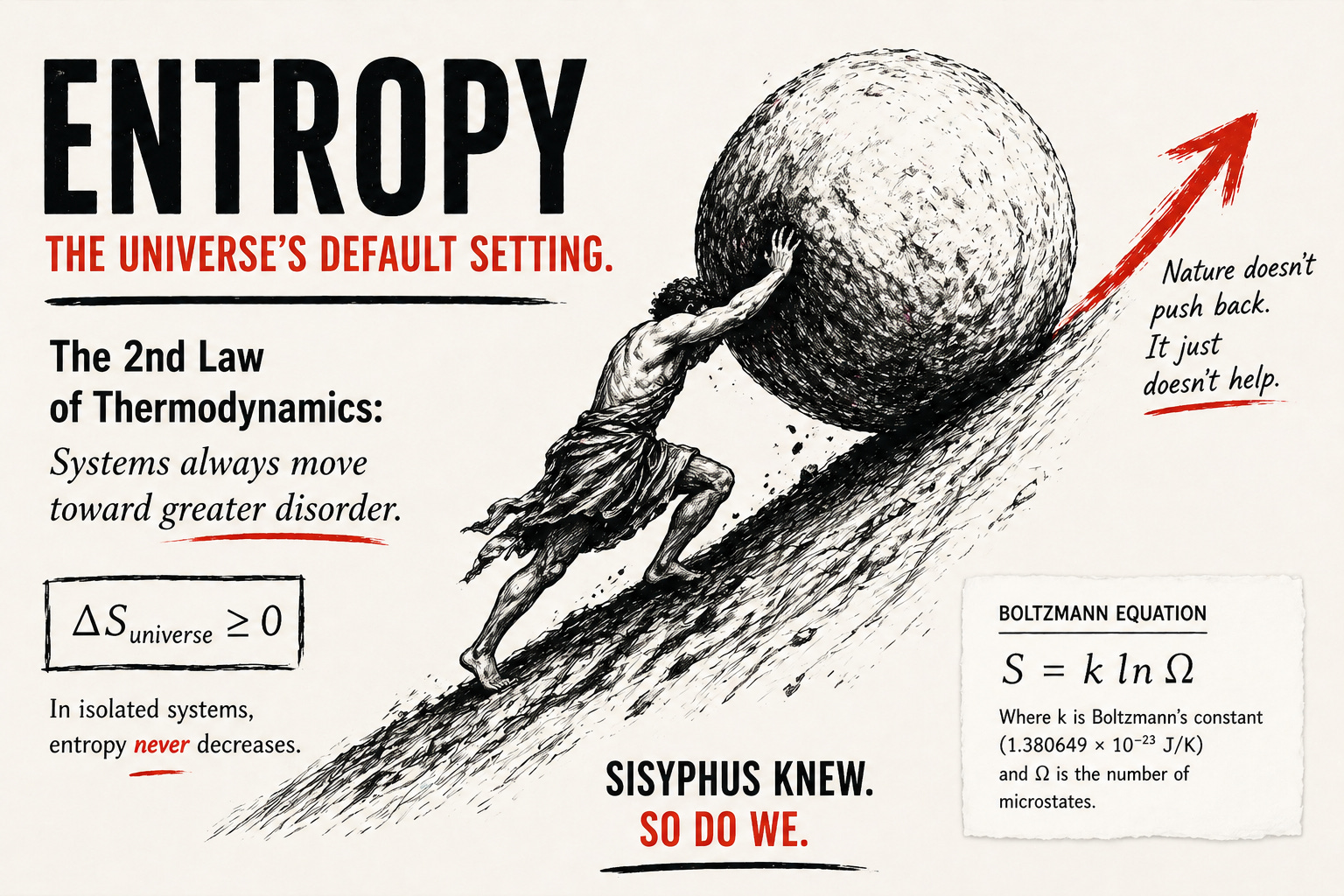
The first dictionary definition of entropy is boring — lots of random equations. The second one stops me every time: gradual decline into disorder.
The most obvious example is cleaning. The moment you finish, disorder sets in. Before long, it’s like you never started.
One Sunday morning, I learned this the hard way. Full of energy, Wu-Tang locked in, I spent three hours on a kitchen and laundry pile that had been building for weeks. By hour three, the dust and my age were winning. And then the thought crept in: What’s the point?
Not existential angst. Thermodynamics.
The second law states that systems always move toward greater disorder. Left alone, things fall apart. It’s true for kitchens. It’s true for the rest of life too — lose weight, gain it back. Become smart, stop reading, forget. Don’t invest in a relationship; become strangers. The decline can be so severe that it’s like the progress never happened.
Ignorance gives entropy permission to steal your hard-won gains. It’s the law.
It shows up everywhere
It’s not just personal. In organizations, entropy doesn’t announce itself. It accumulates.
Strategic entropy is the quietest killer. A winning strategy decays as rivals imitate, markets shift, and needs evolve. Companies that stop investing in renewal don’t fail dramatically — they become gradually irrelevant.
Cultural entropy is slower still. Early values get diluted as teams scale or short-term pressure overrides long-term principles. Cynicism and disengagement aren’t morale problems. They’re symptoms.
Talent entropy is the most personal. Skills become obsolete. High performers leave when treated as an afterthought. Institutional knowledge walks out the door — and nobody notices until it’s gone.
The other face of entropy: randomness
Entropy isn’t only about decline. It’s also about randomness — the curveballs that derail best-laid plans, and occasionally, the ones that exceed them.
How often do we make room for random events disrupting what we’ve built? And how often are we open to something completely unexpected that would require us to rewrite the plan entirely?
Our logical minds want to assign blame when things go wrong — build a theory, find a culprit, restore the illusion of control. But sometimes things fall apart because systems tend toward disorder. Giving yourself a break and chalking some of it up to the universe isn’t weakness. It’s physics.
Fighting back
Treat nothing as sacred. Periodically reassess whether the things you’ve built — habits, roles, processes, relationships — still serve you. Reorganization isn’t failure. Refusing to reorganize often is.
Make your strategy a living thing. In work and in life, schedule the reviews. Be willing to kill what no longer fits. A plan that hasn’t been stress-tested recently is probably already decaying.
Don’t let what matters live only in your head. Write it down. The things worth preserving — processes, values, intentions — need a home outside memory.
Ave, Sisyphus
Entropy always wins by default. The only question is how fast.
The most resilient people — and organizations — treat entropy as a permanent condition to manage, not a problem to solve once and forget. That means continuous reinvestment. It means acting like an open system that draws in fresh energy, rather than a closed one quietly running down.
It does feel like shoveling dirt against the tide. But that’s not a reason to stop. That’s just the nature of the work.
So before committing to any new venture — professional, personal, creative — ask yourself two things: can you preserve the gains you already have, and do you have the fortitude to push through the randomness ahead?
Because if not, the tide already won.
What are you committed to not letting decay? Tell me below.
This resonated deeply, Hari. Back when I was a practicing CFP, I used to half-jokingly tell people my primary job title was Entropy Fighter. Financial plans are closed systems, and without a constant infusion of fresh energy and reorganization, they succumb to that gradual decline into disorder you described so well.
Loved your approach to keeping entropy at bay. I’ve also found that the best defense is a multi-modal approach: using redundancy like an engineer to buffer against the unknown, and maintaining biological-style adaptation so the plan can evolve as the environment shifts.
Excellent piece! It’s a reminder that the work of preservation is never truly done.
Thanks for the restacks, everyone!