
Mosaic Signals 003: AI, AI, AI
Interest Rates, Inflation, & Infrastructure


Mosaic Signals are mid-cycle updates between our twice-monthly flagship pieces. High signal and improvisation.
Hi Reader,
It’s Hari. Over mediocre chicken satay, a few friends and I fell into a conversation about distrust — in data, in facts, in numbers that used to feel settled. Some of it is the AI era: when anything can be generated, nothing feels verifiable. We couldn’t even agree on whether New York or Florida had more COVID deaths. A fact. Publicly available. Still contested at the table. Mosaic Signals wants to help — each installment will take data points, break down what they actually measure, where they fall short, and what they mean for your decision-making.
PS: On a completely separate note- Recently went on a Flushing, NY Food Tour that’s a bit off the beaten path (and inexpensive). Reply if you want the list of restaurants!
Signal 001:
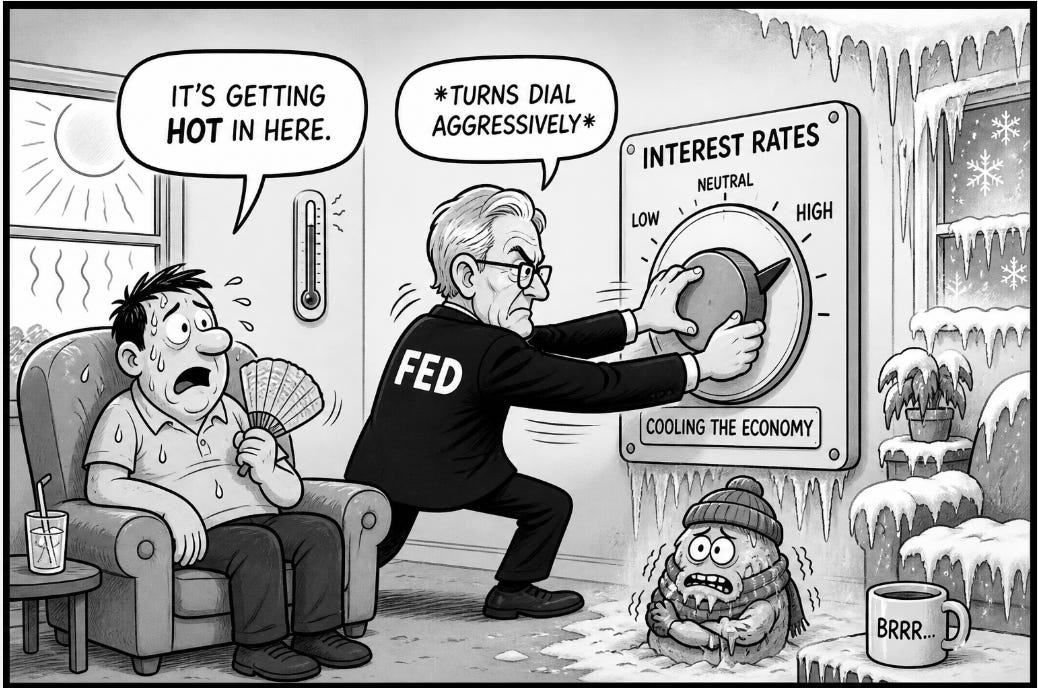
Fed Decision: Rates Held at 3.5–3.75%
Who: A small group of government officials, led by Chair Jerome Powell, meets several times a year to decide how expensive borrowing money should be in America. Most agreed on this one; a few didn't. That decision ripples through everything: your mortgage, your car loan, your credit card, and the entire stock market.
What: They decided to leave interest rates right where they are. Translation: borrowing money stays about as expensive as it’s been. Your mortgage rate isn’t getting any relief today.
When: Last week’s meeting. But their eyes are on what comes next.
Where: All about the U.S. economy, though what’s happening abroad (think Middle East) is very much on their radar.
Why: Honest answer: it’s complicated. The economy is still humming along. People still have jobs. But hiring has slowed down, and prices are still higher than the Fed would like, especially for gas and energy. Add in global uncertainty, and they’d rather wait than risk making the wrong call.
How: Watch and wait. They’re not on autopilot. They’re tracking jobs, prices, and markets closely and have made clear they’ll act if things shift.
Bottom line: Nothing’s broken, but nothing’s fixed either. So for now, they’re holding their breath a little.
Many think rates should be cut to stimulate the economy. Why, you ask? Mental Mosaic has a Federal Reserve primer in the works. No spoilers. Interestingly, Devil Wears Prada 2 also touched on this. Now we have to beat the mythical four-part series. No pressure.
Signal 002:
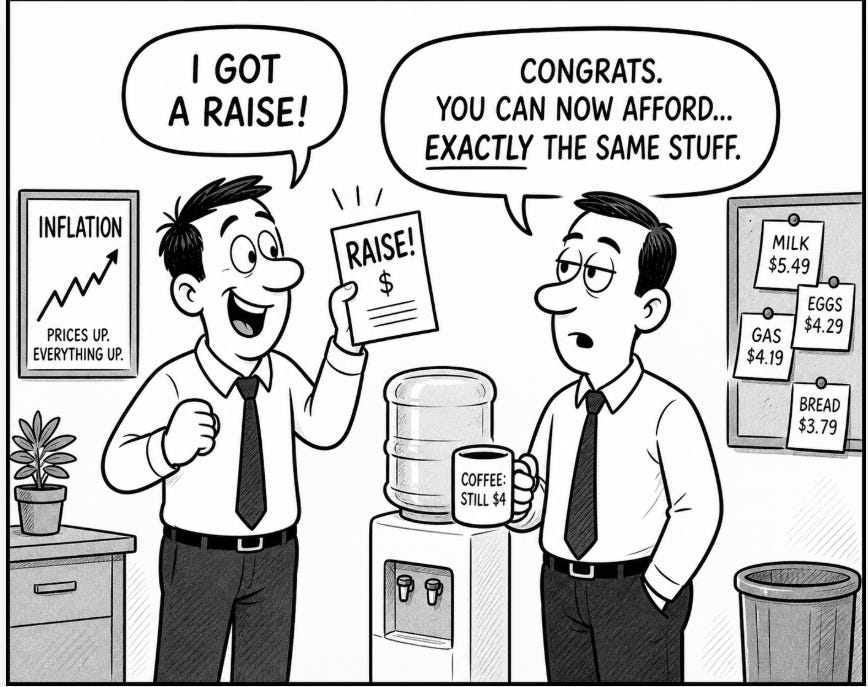
Second Signal: Inflation is Up
1. Inflation is back up, 3.5% (PCE)
Biggest jump in about three years. And here’s the thing: it’s not because people are suddenly spending recklessly. It’s mostly energy prices, driven by geopolitical developments. That said, when energy gets expensive, everything gets a little more expensive. So the ripple effects are real.
2. People are spending more than they’re earning
Income grew 0.6% last month. Spending grew 0.9%. The gap has to come from somewhere, and right now it’s coming from savings and a little bit of financial stretch. Consumers are still showing up, just not quite as comfortably as before.
The (slightly simplified) chain of events, if you zoom out
Oil gets expensive
Producers raise prices to protect their profits, so items in the checkout aisle get expensive
Salaries don’t keep up, real wages shrink quietly
Consumers keep spending anyway, just with less cushion
The Fed wants more data before acting
Repeat
Bottom line: The economy is still moving. But it’s being carried by consumers running a little hotter than their wallets probably should.
Signal 003:
Five companies basically make up the market.
The five biggest Magnificent Seven names now total $15.5 trillion in market cap — that’s 35 to 40% of the S&P 500 and nearly a fifth of the entire U.S. stock market.
Recent earnings were mixed. Apple, Alphabet, and Amazon had good quarters. Meta and Microsoft lagged.
Why it matters: A handful of companies aren’t just leading the market. They’re writing the entire story. When people wonder why they may not feel as prosperous as the stock market does, this is partly why.
AI doesn’t run on code. It runs on electricity and water.
Data centers use about 3-4% of all U.S. electricity today. By 2030, that could hit 8 to 10%. A single large AI facility draws as much power as a city of 400,000 people.
Cooling is the hidden problem. We’re talking millions of gallons of water per day at peak.
The bottleneck isn’t chips or software. It’s power grids and access to water.
Why it matters: The race to build AI is quietly becoming a race to secure infrastructure most people never think about.
Where you build is now a competitive advantage.
A one-tenth-of-a-second delay costs companies roughly 7% of their sales. Why?
Online shoppers are impatient. A tiny lag is enough to make someone click away, and at the scale these companies operate, even a fraction of a second translates into millions in lost revenue. So companies are moving data centers closer to users, even when it costs more.
Why it matters: The cloud isn’t abstract. It’s physical, and location is starting to determine who wins.
The big picture: Money flows into Big Tech, Big Tech bets on AI, and AI hits real-world constraints like power, water, and geography. That’s the pattern worth watching.
Bottom line: The market’s AI giants have a software lead. Their next constraint is whether they can keep the lights on and the servers cool.