
Mosaic Minds #5: Thinking of buying an AI stock?
Beware the ghost of the Dotcom Bubble


Elon Musk became the world’s first trillionaire – for around a few days until he dropped down to billionaire status again, then back up to trillionaire, again. And who knows where he’ll end up when this piece is published.
This was largely due to the SpaceX IPO being the largest in history. And we know, thanks to their S1 filing, that this was largely because the offering was sold as an AI play, with SpaceX expecting its AI division to roughly reach the GDP of the US by the 2030s.
Bubble, bubble, toil and trouble: This has all the hallmarks of an overhyped stock in the middle of a feeding frenzy, with many, including legendary investor Ray Dalio, calling it a bubble. The truth is – as with all bubbles – you never really know you’re in one.
It’s especially hard to know when the case for the underlying sector is fundamentally sound. AI is revolutionary and is changing the world (cringe as that kind of talk has become). And it’s already embedded in most of our devices and is used ubiquitously now.
This reminds us of another similar bubble: The dotcom bubble of 2000, whose damage was counted in the trillions. In that one, the underlying sector was sound. The move towards the internet was growing at a seemingly exponential rate. Yet millions lost their investments and savings.
One such unlucky investor was Stephen Malinak, our Mosaic Minds contributor.
In today’s Mosaic Minds, he tells us his experience of going big on another such bubble: the crash in telecoms during the dotcom bubble, his losses and the lessons learned.
Danger, Will Robinson: But mostly, it is a stark warning of how just because the hype is real, doesn’t make the stock immune from the market’s boom and bust cycle, and how even being an industry insider doesn’t make one immune.
Don’t Buy the Top of a Generational Bubble
How I blew up my wife’s first retirement account when the Internet Bubble burst
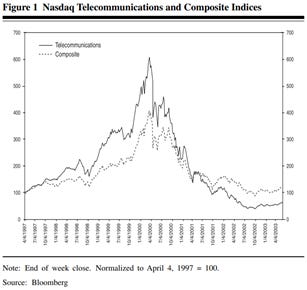
Wise investors know not to go all in at the peak of a speculative bubble. Yet that’s exactly when crowds most want to buy. Here’s how I got sucked into buying the top of a telecom bubble that grew bigger than the overall Internet bubble and crashed even harder. This cautionary tale feels familiar to the possible AI bubble building today. It’s a great time to think carefully about timeless principles such as valuation, position sizing, and risk management.
Disclaimer: I am a financial analyst, not a licensed financial adviser. No one knows how much higher the stock market may go or how hard it may eventually fall. I am sharing my historical experience for educational purposes.
I’d Been Working on the Railroad
As the dot-com bubble neared its peak in 1999, I was working as a strategy consultant for Union Pacific Railroad, who turned out to be a major provider of the Internet’s telecom infrastructure: cross-country fiber, advanced wireless tech, and shipment tracking software.
This project gave me a front-row seat to the telecom bubble, as a telecom analyst. Comparable standalone telecom and e-commerce companies traded at 10-100x revenues or more. In Q1 2000, these valuation multiples doubled. I kept asking myself, how could I get a piece of the action?
Meet George Gilder
While flying to my client site each week, I read tech magazines to keep up with my 20-something entrepreneur peers in Silicon Valley.
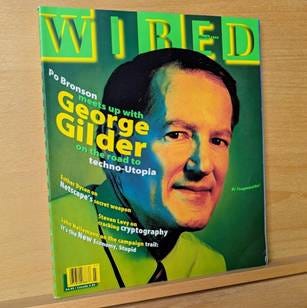
Forbes ASAP prominently featured “futurist” and telecom tech guru George Gilder as their lead columnist. After several years of missing out on outrageous returns, I finally subscribed to the Gilder Technology Report in 1999 to get his specific stock picks.
Gilder’s futuristic Telecosm thesis was basically right. He accurately described the world we live in now, with Netflix streaming video, Spotify audio, Zoom teleconferencing, and Teladoc telemedicine. But it took until Covid, 20 years later, for most of these broadband applications to become mainstream. None of these application companies were on Gilder’s 1999 list; they all emerged much later after two stock market busts (2000 and 2008).

Gilder favored the classic “picks and shovels” play during the Internet goldrush. These were the fiber, wireless, and technology providers building the physical Internet, analogous to the explosive AI datacenter buildout of today.
What Happened to the Telecom Darlings?
I invested much of my wife’s newly opened retirement account into a handful of Gilder’s recommendations, keeping my own larger retirement account much more diversified. In aggregate, these telecom darlings crashed 80% or more by the time I capitulated what was left into cash.
· Worldcom, -100% (bankrupt)
· JDS Uniphase, -99.8%
· Global Crossing, -99.5%
· Nortel, -99.5%
· Lucent, -99.3%
· Level 3, -98% (acquired)
What Timeless Principle Did I Violate?
Don’t buy the top of a speculative bubble. I wasn’t the first to do this, and I won’t be the last. The same thing happened to Sir Isaac Newton, one of the most prominent intellectuals of the 1700s.
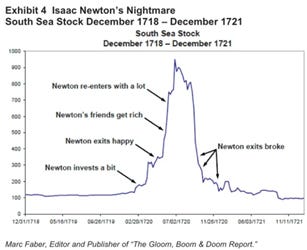
Ultimately, Newton admitted his inability to deal with FOMO and the madness of crowds.

I had even read an 1841 book explaining the Tulip and South Sea Bubbles, but that did not dissuade me. When my co-worker told me the book title, I didn’t believe him:

What Did I Learn?
· Market timing matters: bubbles top when speculative interest peaks
· Valuation matters: watch out for companies trading at 100x revenues (where SpaceX IPOd)
· Risk management matters: avoid extreme concentration and respect downward trend breaks
· Narrative ≠ financial advice: “experts” may ultimately be proved correct only after you’re wiped out
· Follow the smart money: my client was selling telecom assets, not buying more
What Saved Me?
The main thing I got right was position sizing, as I took the concentrated bet in the much smaller account. My main account fared much better, and I had already taken some profits and invested in real estate that almost immediately doubled. Losing 80% on a tiny account taught me not to lose 80% on a large account later.
How Does Today Rhyme?
Drawing a full comparison of today to 1999 is beyond the scope of this brief article. But here are some parallels that concern me:
· High concentration in a small number of stocks: Mag7 in the US, Samsung in Emerging Markets
· Concentration results in large unintended bets by passive index investors
· High valuation multiples on top companies, with momentum overwhelming value
· AI narrative dominating public discourse much as the Internet did in 1999
· Hot ball of money has moved from crypto to AI as crypto bros are now “AI experts”
· Vendor financing supporting AI buildout, much as telecom vendors funded their own customers
Proceed with caution and do your own research if you’re heavily exposed here.
 | A guest post by
|
Interesting take!