
Mosaic Minds #4: The Power of Doing Nothing
Inaction in an Action-Obsessed World


Hi Reader,
It’s Hari. We’ve often spoken here about the nature of leadership and decision-making. And one could be forgiven for thinking that we (as with many other advice-related platforms) only encourage determined and decisive action. Sometimes that encouragement to act can seem to come even when there’s not enough data to support a decision, or when the timing and the way forward aren’t clear. Almost like a crowd at a roulette table encouraging a gambler on a hot streak. When they win, we feel like we were a part of the moment. If they lose, well, we simply forget about them and move on.
Our next Mosaic Minds contributor is here to set the record straight: Not all choices are opportunities that must be pounced on, and sometimes the best time to make a choice is after the feeling of FOMO goes away. John Field is a trader and financial writer who pens The Trading Path on Substack, where he focuses on cycles, risk, and making better decisions in markets without relying on perfect timing.
The Most Profitable Decision I Made Was Doing Nothing
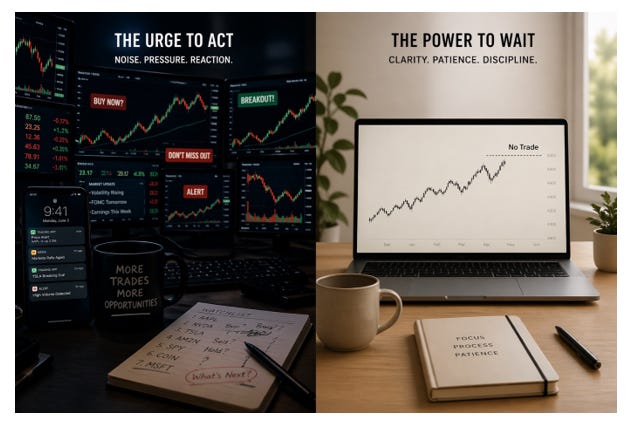
Most of the mistakes I’ve made in both trading and business came from the same place. Not bad ideas. Not lack of knowledge. Just acting when I didn’t need to.
In trading, this shows up late in a cycle. Everything looks strong. Prices are moving. Confidence is high. It feels like there is still opportunity left. So you act. You add. You chase. You convince yourself there’s one more move.
Sometimes you’re right. But more often, you’re stepping into a phase where the quality of opportunity has already started to decline. That’s the part most people miss.
I had a moment like this recently in business. An opportunity came up that, on paper, looked right. It would have added revenue. It felt like progress. There was a bit of urgency around it as well. The kind of decision that’s easy to justify.
But something didn’t quite sit right. Not in a dramatic way. Just a quiet sense that the timing wasn’t aligned. That it would add complexity rather than clarity. Everything around me was pushing towards action.
So I paused. I didn’t say yes. I didn’t say no. I just did nothing.
At the time, it felt uncomfortable. There’s always a sense that you might be missing out. Not acting is the same as falling behind. But over the following weeks, the picture became clearer. The opportunity didn’t improve. The urgency faded. The downsides became more obvious. And the decision made itself.
That’s when it clicked. Doing nothing wasn’t hesitation. It was part of the process.
We tend to think of decision-making as action. Choose. Commit. Move. But in reality, good decisions are often about filtering. Removing what doesn’t align. Letting time expose what isn’t obvious at first.
I now think about decisions in a much simpler way. Before acting, I ask:
Am I responding to pressure or to clear conditions?
Does this still make sense if I remove the urgency?
Would I be comfortable if this doesn’t work immediately?
If those answers aren’t clear, I wait.
This applies just as much to business as it does to markets. In trading, doing nothing late in a cycle protects capital. In business, it protects time, energy, and focus. Both matter more than any single opportunity.
The instinct to act is strong. It feels productive. It feels like progress. But some of the best decisions don’t look like decisions at all. They look like restraints.
Because the goal isn’t to take every opportunity. It’s to stay aligned long enough to recognize the right ones.
 | A guest post by
|
As a new trader, I can relate to that with the price action of Bitcoin recently. It has been chopping sideways for longer than it normally does during bear markets, and I was beginning to wonder if I was missing out, until today it crashed. Now I am glad I didn't make the trade.